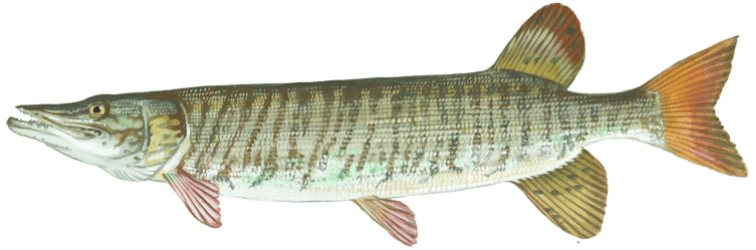
Tiger Musky
Esox masquinongy × Esox lucius
Overview
The tiger musky is a striking hybrid between the muskellunge and the northern pike, combining the impressive size potential of the musky with the more aggressive feeding behavior of pike. Named for the distinctive dark vertical bars and wavy tiger-stripe markings on their flanks, tiger musky are produced both naturally in waters where musky and pike coexist and through deliberate hatchery programs designed to create a high-quality sport fish. Tiger musky are generally sterile, which makes them ideal for fisheries management, as they grow quickly, feed aggressively, and do not reproduce to upset the ecological balance of stocked waters. They are more willing to strike a fly than pure muskellunge, making them a relatively accessible entry point into the world of big-game pike-family fly fishing. Tiger musky can exceed 50 inches and 30 pounds in productive waters, offering the same heart-stopping strikes and powerful fights as their parent species.
pikeNot assessed by IUCN; a hatchery-produced hybrid stocked for sport fishing; has no independent conservation status but contributes to recreational fisheries management
Taxonomy
Order
Esociformes
Family
Esocidae
Genus
Esox
Species
E. masquinongy × E. lucius
Habitat & Behavior
Clear, cool lakes with abundant weed growth, rocky structure, and deep water access; similar habitat preferences to both parent species but more tolerant of varied conditions
Native Range: Occurs naturally in a few lakes where muskellunge and northern pike ranges overlap, primarily in the upper Great Lakes region and southern Canada
Introduced Range: Widely stocked for sport fishing in lakes and reservoirs across the northern and midwestern United States, from Vermont to Washington state
Diet
Piscivorous predator feeding on perch, sunfish, suckers, minnows, and other available fish; more aggressive and less selective than pure muskellunge in feeding behavior
Spawning
Tiger musky are functionally sterile hybrids and do not reproduce successfully in the wild. While they may exhibit spawning behavior in spring, any eggs produced are not viable. This sterility is a fisheries management advantage, as it prevents overpopulation and allows precise control of stocking densities.
Spawning Months
Jan
Feb
Mar
Apr
May
Jun
Jul
Aug
Sep
Oct
Nov
Dec
Spawning Temperature: 48-56°F (spawning behavior exhibited but reproduction unsuccessful)
Conservation Status
Not assessed by IUCN; a hatchery-produced hybrid stocked for sport fishing; has no independent conservation status but contributes to recreational fisheries management
The Tiger Musky is currently classified as Not assessed by IUCN; a hatchery-produced hybrid stocked for sport fishing; has no independent conservation status but contributes to recreational fisheries management. Responsible catch-and-release practices help protect populations for future generations of anglers.
Fly Fishing Tips
Tiger musky are more aggressive than pure muskellunge and will often commit to the fly more readily. Use the same large flies and techniques as musky fishing but expect more frequent follows and strikes. The figure-eight leader movement at the end of each retrieve is still crucial, as tiger musky will often follow to within inches of the rod tip before striking.
Tackle Recommendations
A 9-foot 9 to 11-weight rod capable of casting large flies. Wire or 60-80 lb fluorocarbon bite tippet is essential. A reel with a smooth drag and 150+ yards of 30 lb backing is recommended.
Distribution Map
Recommended Fly Patterns
Articulated Streamer #3/0-6/0
Game Changer #3/0-6/0
Deceiver #2/0-5/0
Popper #2/0-5/0
Buford #3/0-6/0
Woolly Bugger #1/0-4/0
Swim Fly #2/0-5/0
Where to Find Tiger Musky


Rivers with Tiger Musky


Quick Facts
- Scientific Name
- Esox masquinongy × Esox lucius
- Family
- pike
- Average Size
- 28-38 inches, 6-15 lbs
- Record Size
- 51 lbs 3 oz (Lac Vieux Desert, Michigan/Wisconsin border, 1919)
- Lifespan
- 12-18 years, with growth rates typically exceeding those of pure muskellunge in managed fisheries
- Water Temp Range
- 50-75°F (optimal 58-72°F)
- Native Range
- Occurs naturally in a few lakes where muskellunge and northern pike ranges overlap, primarily in the upper Great Lakes region and southern Canada
- Conservation
- Not assessed by IUCN; a hatchery-produced hybrid stocked for sport fishing; has no independent conservation status but contributes to recreational fisheries management
Fun Facts
- Tiger musky grow faster than either parent species in their first few years of life, a phenomenon known as hybrid vigor
- Their sterility makes them a fisheries manager's dream, as stocking rates can be precisely controlled without worrying about natural reproduction
- The distinctive tiger stripe pattern varies between individuals, with no two tiger musky having exactly the same markings
- Tiger musky are generally more aggressive feeders than pure muskellunge, making them somewhat less deserving of the 10,000 casts reputation
Size Reference
Average Size
28-38 inches, 6-15 lbs
World Record
51 lbs 3 oz (Lac Vieux Desert, Michigan/Wisconsin border, 1919)