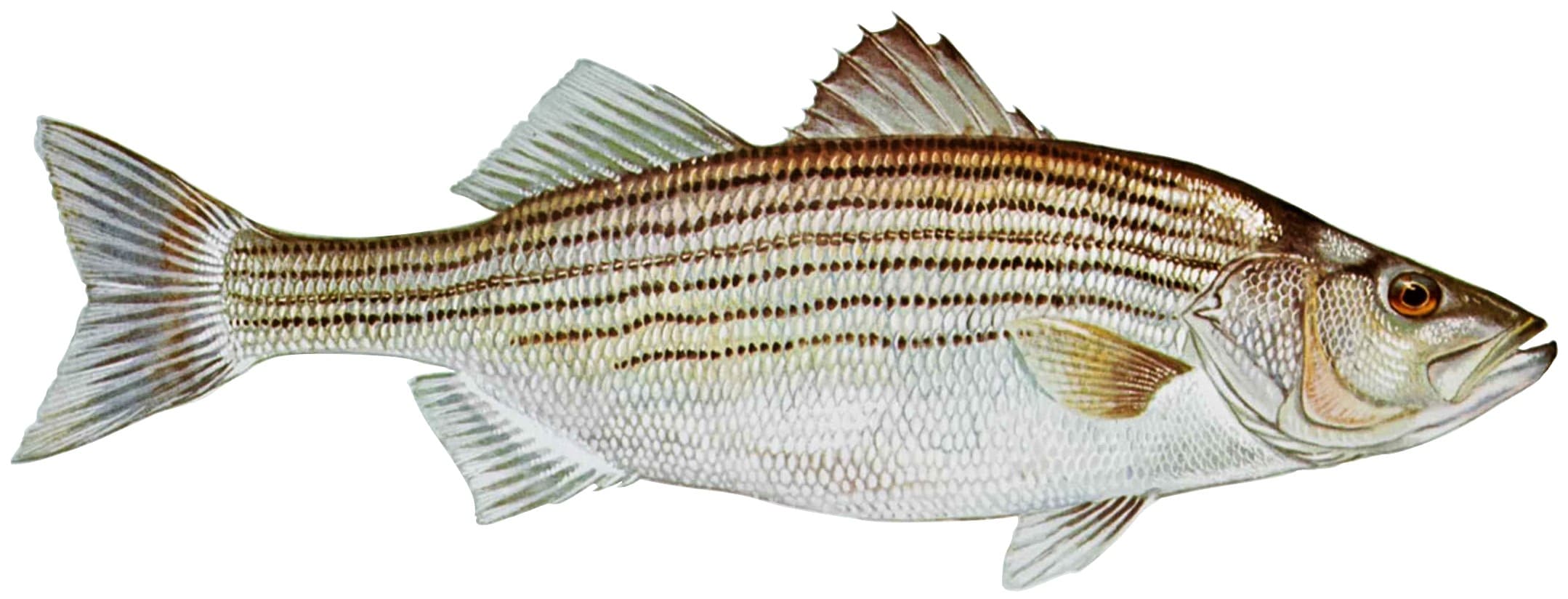
Striped Bass
Morone saxatilis
Overview
The striped bass is the premier game fish of the Atlantic coast, drawing millions of anglers from Maine to the Carolinas each year. Known colloquially as stripers, linesiders, or rockfish, striped bass are large, powerful predators distinguished by their silver bodies marked with seven to eight dark horizontal stripes running from gill to tail. Striped bass undertake one of the most impressive migrations on the eastern seaboard, traveling from their Chesapeake Bay and Hudson River spawning grounds north to New England and back each year. Fly fishing for striped bass has exploded in popularity, with anglers targeting fish from the surf, on shallow flats, around rocky structure, and in tidal rivers and estuaries. The species offers remarkable versatility, as stripers can be caught on topwater poppers, swung deceiver patterns, and deep-drifted weighted flies throughout the season. Their availability, fighting power, and the variety of environments they inhabit make them one of the most complete fly rod game fish available.
saltwaterOverfished according to recent Atlantic States Marine Fisheries Commission assessments; strict slot limits and harvest restrictions implemented to rebuild the spawning stock
Taxonomy
Order
Moroniformes
Family
Moronidae
Genus
Morone
Species
M. saxatilis
Habitat & Behavior
Coastal waters including rocky shorelines, sandy beaches, tidal rivers, estuaries, jetties, harbors, and shallow flats; highly migratory along the Atlantic seaboard
Native Range: Atlantic coast of North America from the St. Lawrence River south to the St. Johns River in Florida, with major spawning populations in the Chesapeake Bay and Hudson River
Introduced Range: Pacific coast of North America from British Columbia to Baja California; also landlocked reservoir populations throughout the United States
Diet
Menhaden, herring, anchovies, sand eels, squid, crabs, lobsters, and a wide variety of other fish and crustaceans; highly opportunistic predators that adapt feeding strategies to available prey
Spawning
Striped bass spawn in freshwater and brackish tidal rivers from April through June, with the Chesapeake Bay producing the majority of Atlantic coast fish. Females broadcast millions of semi-buoyant eggs into the current, which must remain suspended by flowing water to develop properly. Spawning success varies dramatically with water flow and temperature conditions.
Spawning Months
Jan
Feb
Mar
Apr
May
Jun
Jul
Aug
Sep
Oct
Nov
Dec
Spawning Temperature: 55-68°F
Conservation Status
Overfished according to recent Atlantic States Marine Fisheries Commission assessments; strict slot limits and harvest restrictions implemented to rebuild the spawning stock
The Striped Bass is currently classified as Overfished according to recent Atlantic States Marine Fisheries Commission assessments; strict slot limits and harvest restrictions implemented to rebuild the spawning stock. Responsible catch-and-release practices help protect populations for future generations of anglers.
Fly Fishing Tips
Striped bass are ambush predators that use structure, current, and tidal flow to trap prey. Fish around rip lines, rocky points, bridge pilings, and inlet mouths during moving tides for the best action. Dawn and dusk produce the most consistent surface feeding, when poppers and gurgler patterns can draw explosive strikes.
Tackle Recommendations
A 9-foot 9 or 10-weight rod is standard for surf and boat fishing. For smaller fish in estuaries, an 8-weight works well. Use intermediate or sinking lines and 15-20 lb fluorocarbon leaders.
Distribution Map
Recommended Fly Patterns
Lefty's Deceiver #1/0-4/0
Clouser Minnow #1/0-4/0
Surf Candy #1/0-2/0
Crease Fly #1/0-2/0
Gurgler #1/0-2/0
Flatwing #2/0-4/0
EP Minnow #1/0-3/0
Where to Find Striped Bass


Rivers with Striped Bass

Quick Facts
- Scientific Name
- Morone saxatilis
- Family
- saltwater
- Average Size
- 20-32 inches, 5-15 lbs
- Record Size
- 81 lbs 14 oz (Long Island Sound, Connecticut, 2011)
- Lifespan
- 25-35 years, with large females (cows) being the most productive spawners
- Water Temp Range
- 55-75°F (optimal 60-70°F for feeding activity)
- Native Range
- Atlantic coast of North America from the St. Lawrence River south to the St. Johns River in Florida, with major spawning populations in the Chesapeake Bay and Hudson River
- Conservation
- Overfished according to recent Atlantic States Marine Fisheries Commission assessments; strict slot limits and harvest restrictions implemented to rebuild the spawning stock
Fun Facts
- Striped bass were among the first fish protected by conservation legislation in the New World, with the Massachusetts Bay Colony passing a law in 1639 banning their use as fertilizer
- A large female striped bass can release over 4 million eggs in a single spawning event
- The hybrid between striped bass and white bass, known as the wiper, is widely stocked in reservoirs for sport fishing
- Striped bass can tolerate both freshwater and saltwater, and landlocked populations thrive in reservoirs hundreds of miles from the ocean
Where to Find
Size Reference
Average Size
20-32 inches, 5-15 lbs
World Record
81 lbs 14 oz (Long Island Sound, Connecticut, 2011)