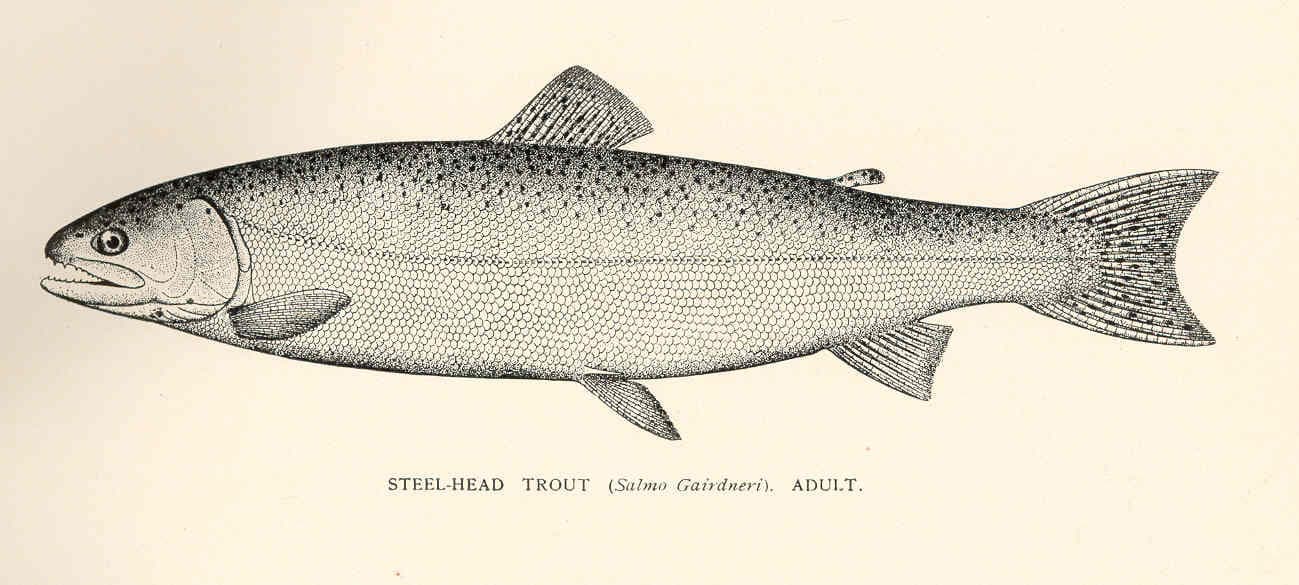
Steelhead
Oncorhynchus mykiss (anadromous)
Overview
Steelhead are the anadromous form of rainbow trout, spending their juvenile years in freshwater rivers before migrating to the ocean where they grow rapidly and develop their characteristic chrome-bright coloring. Returning to their natal rivers to spawn, steelhead are prized as one of the most challenging and rewarding fly rod quarries in North America. Unlike Pacific salmon, steelhead are iteroparous, meaning they can survive spawning and return to the ocean to repeat the cycle multiple times. Fly fishing for steelhead demands patience, persistence, and refined technique, as these powerful fish can go hours or even days between takes. The classic approach uses a two-handed spey rod to swing wet flies through long runs and tailouts, though nymphing and indicator techniques are also highly effective. Landing a wild steelhead on a swung fly is considered by many to be the pinnacle of freshwater fly fishing achievement.
troutMultiple Distinct Population Segments are listed as Threatened or Endangered under the ESA; wild runs throughout the Pacific Northwest have declined significantly
Taxonomy
Order
Salmoniformes
Family
Salmonidae
Genus
Oncorhynchus
Species
O. mykiss
Habitat & Behavior
Large coastal rivers with deep runs, gravel tailouts, and boulder-strewn pools; ocean habitat includes nearshore and open ocean environments
Native Range: Pacific Coast drainages from Southern California north to the Kamchatka Peninsula in Russia
Introduced Range: Great Lakes tributaries, select rivers in the eastern United States, Chile, and Argentina
Diet
In the ocean: forage fish (herring, anchovies, smelt), squid, shrimp, and krill; in rivers during spawning runs: largely non-feeding but will strike flies out of aggression and territorial behavior
Spawning
Steelhead spawn in gravel-bottomed rivers from late winter through spring. Winter-run fish return to rivers from November through April, while summer-run fish enter rivers from May through October but hold until conditions are right. Unlike salmon, steelhead can survive spawning and return to sea.
Spawning Months
Jan
Feb
Mar
Apr
May
Jun
Jul
Aug
Sep
Oct
Nov
Dec
Spawning Temperature: 42-52°F
Conservation Status
Multiple Distinct Population Segments are listed as Threatened or Endangered under the ESA; wild runs throughout the Pacific Northwest have declined significantly
The Steelhead is currently classified as Multiple Distinct Population Segments are listed as Threatened or Endangered under the ESA; wild runs throughout the Pacific Northwest have declined significantly. Responsible catch-and-release practices help protect populations for future generations of anglers.
Fly Fishing Tips
Swinging flies on a spey rod through classic steelhead runs is the traditional and most rewarding approach. Fish the water methodically, taking a step downstream between each cast. Early morning, late evening, and overcast days tend to produce the most aggressive takes to a swung fly.
Tackle Recommendations
A 12 to 13-foot 7 or 8-weight spey rod is standard for swinging flies. For nymphing, a 10-foot 7-weight single-hand rod works well. Use stout 8-12 lb tippet.
Distribution Map
Recommended Fly Patterns
Intruder #2-6
Egg-Sucking Leech #2-6
Skagit Minnow #1/0-4
Green Butt Skunk #4-8
Popsicle #2-4
Glo Bug #6-10
Stonefly Nymph #4-8
Where to Find Steelhead


Rivers with Steelhead


Quick Facts
- Scientific Name
- Oncorhynchus mykiss (anadromous)
- Family
- trout
- Average Size
- 24-32 inches, 6-12 lbs
- Record Size
- 42 lbs 3 oz (Bell Island, Alaska, 1970)
- Lifespan
- 6-11 years, with 1-3 ocean years being most common
- Water Temp Range
- 34-60°F (optimal 42-52°F for fishing)
- Native Range
- Pacific Coast drainages from Southern California north to the Kamchatka Peninsula in Russia
- Conservation
- Multiple Distinct Population Segments are listed as Threatened or Endangered under the ESA; wild runs throughout the Pacific Northwest have declined significantly
Fun Facts
- A steelhead's sense of smell is so acute that it can detect its home stream's unique chemical signature from hundreds of miles away in the ocean
- Steelhead can leap waterfalls up to 11 feet high during their upstream migration
- The distinction between a steelhead and a resident rainbow trout is behavioral rather than genetic
- Some steelhead travel over 900 miles inland from the Pacific Ocean to reach their spawning grounds
Where to Find
Size Reference
Average Size
24-32 inches, 6-12 lbs
World Record
42 lbs 3 oz (Bell Island, Alaska, 1970)