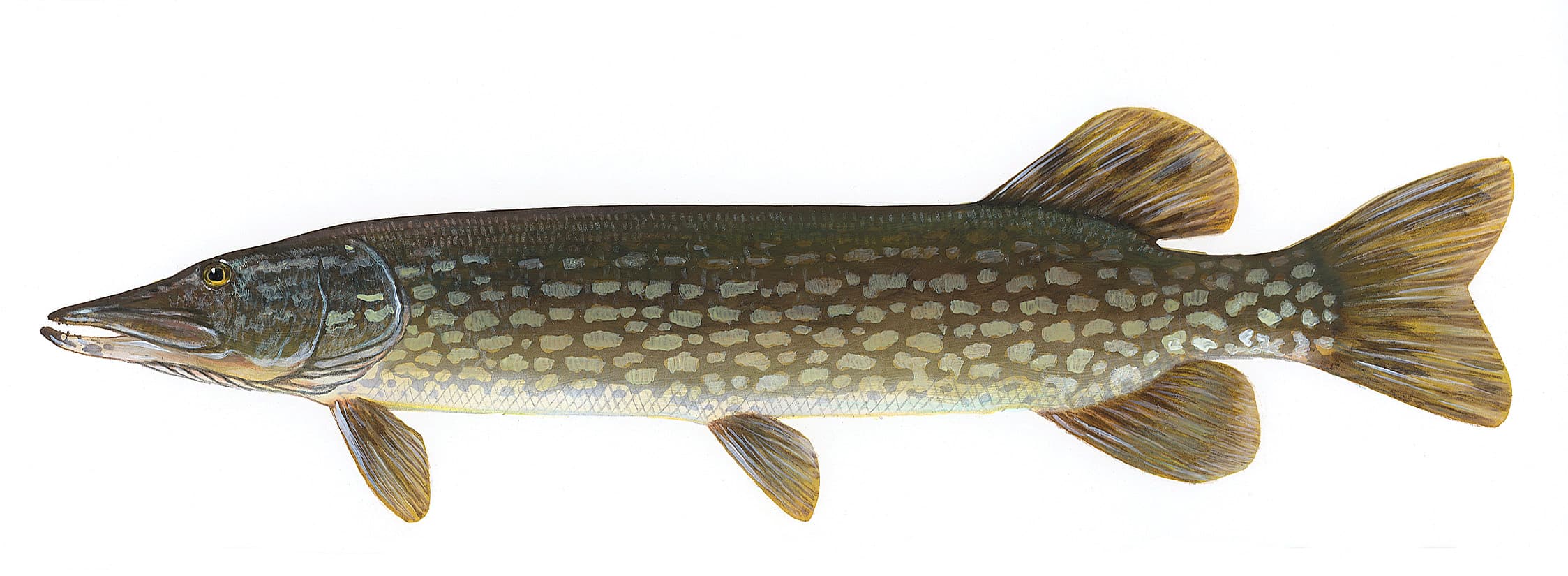
Northern Pike
Esox lucius
Overview
The northern pike is the apex freshwater predator of the northern hemisphere, an ambush specialist with a torpedo-shaped body, a flat, duck-billed snout filled with hundreds of razor-sharp teeth, and an explosive strike that can generate the most violent topwater takes in freshwater fly fishing. Found across the circumpolar north in lakes, rivers, and marshes from Europe through Siberia and across North America, northern pike are among the most widely distributed freshwater fish on Earth. They are powerful, aggressive fish that readily strike large streamers and topwater patterns, making them outstanding fly rod targets for anglers seeking raw, adrenaline-fueled action. Pike fly fishing is at its best in spring and early summer when large fish move into shallow bays and backwaters to feed after the spawn, providing sight fishing opportunities for fish that can exceed 40 inches in length. The visual thrill of watching a pike follow and attack a streamer is an unforgettable experience.
pikeLeast Concern (IUCN); one of the most abundant and widely distributed freshwater predators in the world
Taxonomy
Order
Esociformes
Family
Esocidae
Genus
Esox
Species
E. lucius
Habitat & Behavior
Shallow, weedy bays and backwaters of lakes and slow-moving rivers; marshes, sloughs, and backwater channels with abundant aquatic vegetation for ambush cover
Native Range: Circumpolar distribution across the entire northern hemisphere: North America from Alaska to the eastern seaboard, Europe, and Asia through Siberia
Introduced Range: Southern United States, Spain, Turkey, and various other regions outside the native range; widely distributed through stocking programs
Diet
Highly piscivorous, feeding on perch, walleye, suckers, minnows, and other fish; also frogs, mice, muskrats, ducklings, and essentially any animal that fits in its mouth
Spawning
Northern pike are among the earliest-spawning freshwater fish, moving into flooded marshes and shallow bays immediately after ice-out in March through May. Females scatter eggs over aquatic vegetation in water 6-18 inches deep. No parental care is provided, and eggs hatch in 12-14 days depending on water temperature.
Spawning Months
Jan
Feb
Mar
Apr
May
Jun
Jul
Aug
Sep
Oct
Nov
Dec
Spawning Temperature: 40-50°F
Conservation Status
Least Concern (IUCN); one of the most abundant and widely distributed freshwater predators in the world
The Northern Pike is currently classified as Least Concern (IUCN); one of the most abundant and widely distributed freshwater predators in the world. Responsible catch-and-release practices help protect populations for future generations of anglers.
Fly Fishing Tips
Pike are ambush predators that position themselves along weed edges, around submerged timber, and in shallow bays where they can attack prey from cover. Cast large streamers parallel to weed lines and retrieve with long, steady strips punctuated by pauses. Wire or heavy fluorocarbon bite tippet is absolutely essential to prevent the pike's teeth from severing your leader.
Tackle Recommendations
A 9-foot 8 to 10-weight rod designed for throwing large, wind-resistant flies. Use a wire bite tippet of at least 30 lb and an intermediate or floating line with a pike-specific leader.
Distribution Map
Recommended Fly Patterns
Articulated Streamer #3/0-6/0
Pike Bunny #3/0-6/0
Deceiver #2/0-5/0
Dahlberg Diver #1/0-4/0
Game Changer #2/0-5/0
Pike Popper #2/0-4/0
Clouser Minnow #1/0-4/0
Where to Find Northern Pike


Rivers with Northern Pike


Quick Facts
- Scientific Name
- Esox lucius
- Family
- pike
- Average Size
- 24-36 inches, 4-12 lbs
- Record Size
- 55 lbs 1 oz (Lake of Grefeern, Germany, 1986)
- Lifespan
- 12-20 years, with females living longer and growing substantially larger than males
- Water Temp Range
- 40-72°F (optimal 55-70°F for active feeding)
- Native Range
- Circumpolar distribution across the entire northern hemisphere: North America from Alaska to the eastern seaboard, Europe, and Asia through Siberia
- Conservation
- Least Concern (IUCN); one of the most abundant and widely distributed freshwater predators in the world
Fun Facts
- Northern pike have been documented attacking and consuming ducklings, muskrats, and even small dogs that enter the water
- Their teeth are angled backward, ensuring that prey cannot escape once seized in the pike's jaws
- Pike can strike prey at speeds exceeding 30 miles per hour over short distances from a standing start
- They are one of the few freshwater fish species with a truly circumpolar distribution, found across North America, Europe, and Asia
Where to Find
Size Reference
Average Size
24-36 inches, 4-12 lbs
World Record
55 lbs 1 oz (Lake of Grefeern, Germany, 1986)