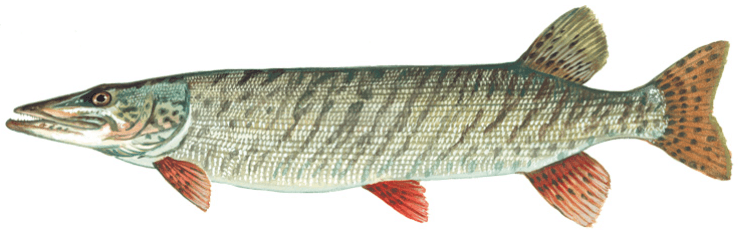
Musky
Esox masquinongy
Overview
The muskellunge, commonly known as musky, is the largest member of the pike family and one of the most elusive and coveted freshwater game fish in North America. Known as the fish of 10,000 casts for the extreme difficulty involved in hooking one, musky grow to enormous proportions, with fish exceeding 50 inches and 40 pounds present in the best fisheries. Musky are apex predators that have no natural enemies in their habitats, sitting atop the food chain in the clear, cool lakes and rivers of the upper Midwest and northeastern United States and southeastern Canada. Fly fishing for musky is an extreme discipline that demands oversized tackle, enormous flies, and an extraordinary level of patience and persistence. When a musky finally commits to the fly, the experience is unforgettable, as these massive fish deliver crushing strikes and bulldog-like fights that test the limits of fly tackle. Dedicated musky fly anglers consider the hours of fruitless casting a worthy investment for moments of peak intensity.
pikeLeast Concern; carefully managed through strict catch-and-release regulations and minimum size limits in most states and provinces; stocking programs maintain populations in many waters
Taxonomy
Order
Esociformes
Family
Esocidae
Genus
Esox
Species
E. masquinongy
Habitat & Behavior
Clear, cool lakes with extensive weed beds, rocky structure, and deep water access; also large rivers with adequate flow and structure; prefers water with visibility of at least 4 feet
Native Range: Great Lakes basin, upper Mississippi and Ohio River drainages, St. Lawrence River system, and Lake of the Woods watershed in the northern United States and southeastern Canada
Introduced Range: Expanded stocking throughout the northeastern and midwestern United States and southeastern Canada in suitable cool, clear waters
Diet
Highly piscivorous, feeding on suckers, walleye, perch, bass, and other fish up to one-third their own body length; also consumes frogs, muskrats, and waterfowl
Spawning
Musky spawn in spring shortly after ice-out when water temperatures reach 48-56°F, typically from April through May. They scatter eggs over shallow, vegetated areas in marshes and bays. No parental care is provided. Musky are slow-growing and late-maturing, with females not reaching sexual maturity until 5-7 years of age.
Spawning Months
Jan
Feb
Mar
Apr
May
Jun
Jul
Aug
Sep
Oct
Nov
Dec
Spawning Temperature: 48-56°F
Conservation Status
Least Concern; carefully managed through strict catch-and-release regulations and minimum size limits in most states and provinces; stocking programs maintain populations in many waters
The Musky is currently classified as Least Concern; carefully managed through strict catch-and-release regulations and minimum size limits in most states and provinces; stocking programs maintain populations in many waters. Responsible catch-and-release practices help protect populations for future generations of anglers.
Fly Fishing Tips
Musky fishing requires mental toughness and endurance. Cast large flies to likely holding areas including weed edges, rocky points, and drop-offs, and make a figure-eight motion with the fly at the end of each retrieve to entice following fish into striking at boat-side. Fall is the prime season for musky on the fly, as fish feed aggressively to build reserves for winter.
Tackle Recommendations
A 9-foot 10 to 12-weight rod capable of throwing flies up to 12 inches long. Use a reel with a strong drag and at least 200 yards of 40 lb backing. Wire or 80 lb fluorocarbon bite tippet is essential.
Distribution Map
Recommended Fly Patterns
Articulated Musky Fly #5/0-8/0
Buford #5/0-8/0
Game Changer #4/0-7/0
Double Deceiver #4/0-7/0
Musky Popper #4/0-6/0
Lynch's Drunk & Disorderly #5/0-8/0
Swim Fly #4/0-6/0
Where to Find Musky


Rivers with Musky


Quick Facts
- Scientific Name
- Esox masquinongy
- Family
- pike
- Average Size
- 30-42 inches, 8-20 lbs
- Record Size
- 67 lbs 8 oz (Lac Court Oreilles, Wisconsin, 1949)
- Lifespan
- 15-30 years, with trophy-class females often exceeding 20 years of age
- Water Temp Range
- 50-75°F (optimal 60-72°F for peak feeding activity)
- Native Range
- Great Lakes basin, upper Mississippi and Ohio River drainages, St. Lawrence River system, and Lake of the Woods watershed in the northern United States and southeastern Canada
- Conservation
- Least Concern; carefully managed through strict catch-and-release regulations and minimum size limits in most states and provinces; stocking programs maintain populations in many waters
Fun Facts
- The nickname fish of 10,000 casts reflects the extraordinary difficulty of hooking a musky, though dedicated anglers dispute this as an underestimate
- Musky are the official state fish of Wisconsin, where they hold an almost mythical status among anglers
- A musky can consume prey up to 40% of its own body length in a single strike
- The musky's metabolism slows dramatically in winter, and fish may go weeks between meals, surviving on stored body fat
Where to Find
Size Reference
Average Size
30-42 inches, 8-20 lbs
World Record
67 lbs 8 oz (Lac Court Oreilles, Wisconsin, 1949)