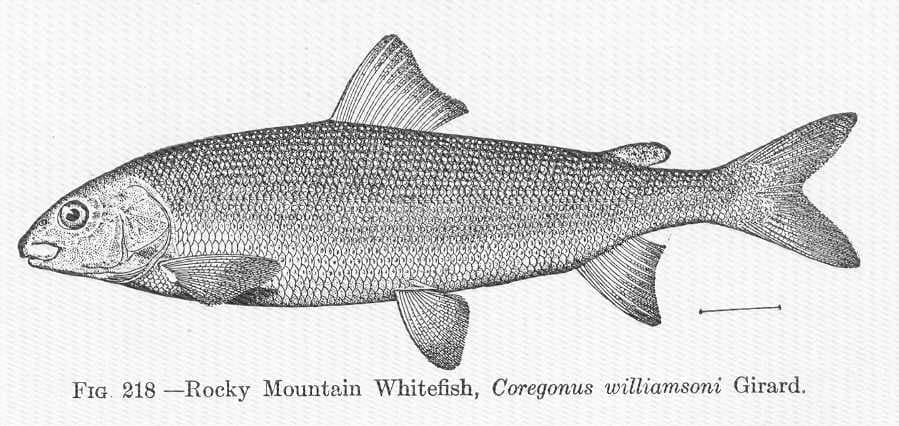
Mountain Whitefish
Prosopium williamsoni
Overview
The mountain whitefish is the unsung hero of western trout streams. Often overlooked or even disparaged by trout-focused anglers, mountain whitefish are native to the cold rivers and lakes of western North America and frequently outnumber trout in many premier fisheries. They are a member of the salmonid family, characterized by their silvery body, small mouth, and forked tail. Mountain whitefish feed primarily on aquatic invertebrates along the river bottom, making them excellent targets for nymph fishers, and they can provide fast-paced action during winter months when trout fishing slows. Increasingly, fly anglers are recognizing mountain whitefish as worthy quarry in their own right, appreciating their strong fights and the skill required to effectively target them with small nymphs and midges. Their importance as a native species in western river ecosystems adds conservation value to their pursuit.
warmwaterLeast Concern; native populations are generally healthy throughout western North America, though some local declines have been noted due to habitat degradation
Taxonomy
Order
Salmoniformes
Family
Salmonidae
Genus
Prosopium
Species
P. williamsoni
Habitat & Behavior
Cold, clear rivers and streams; deep runs and pools with gravel and cobble bottoms; also found in deep, cold lakes and reservoirs throughout the western mountains
Native Range: Western North America, from the Rocky Mountains to the Pacific Coast, from British Columbia south to Nevada and Utah
Introduced Range: No significant introductions outside native range; natural distribution throughout cold western rivers
Diet
Primarily benthic aquatic invertebrates including midge larvae, mayfly nymphs, caddisfly larvae, and small crustaceans; occasionally takes small fish eggs and drifting terrestrial insects
Spawning
Mountain whitefish are fall and early winter spawners, depositing eggs over clean gravel substrates in rivers from October through December. Unlike trout, whitefish do not construct redds but instead broadcast eggs that settle into gravel interstices. Spawning typically occurs at night in shallow riffles.
Spawning Months
Jan
Feb
Mar
Apr
May
Jun
Jul
Aug
Sep
Oct
Nov
Dec
Spawning Temperature: 38-44°F
Conservation Status
Least Concern; native populations are generally healthy throughout western North America, though some local declines have been noted due to habitat degradation
The Mountain Whitefish is currently classified as Least Concern; native populations are generally healthy throughout western North America, though some local declines have been noted due to habitat degradation. Responsible catch-and-release practices help protect populations for future generations of anglers.
Fly Fishing Tips
Mountain whitefish feed almost exclusively on the bottom, so nymphing techniques with weighted flies and indicators are most effective. Use small midge and mayfly nymph patterns drifted close to the substrate in deep runs and pools. Winter fishing can be particularly productive as whitefish continue feeding actively in cold water when trout become lethargic.
Tackle Recommendations
A 9-foot 4 or 5-weight rod is ideal for whitefish nymphing. Use a sensitive indicator setup with 4X-6X tippet and small, weighted nymphs.
Distribution Map
Recommended Fly Patterns
Bead Head Pheasant Tail #16-20
RS2 #18-22
Zebra Midge #18-22
San Juan Worm #12-14
Copper John #16-20
Mercury Midge #20-24
WD-40 #18-22
Where to Find Mountain Whitefish


Rivers with Mountain Whitefish


Quick Facts
- Scientific Name
- Prosopium williamsoni
- Family
- warmwater
- Average Size
- 10-16 inches, 0.5-2 lbs
- Record Size
- 5 lbs 8 oz (Elbow River, Alberta, 1963)
- Lifespan
- 8-14 years, with fish in cold headwater streams growing slowly but reaching considerable age
- Water Temp Range
- 36-64°F (optimal 42-55°F)
- Native Range
- Western North America, from the Rocky Mountains to the Pacific Coast, from British Columbia south to Nevada and Utah
- Conservation
- Least Concern; native populations are generally healthy throughout western North America, though some local declines have been noted due to habitat degradation
Fun Facts
- Mountain whitefish outnumber trout by a ratio of 10 to 1 or more in many premier western rivers, making them the most abundant game fish in these ecosystems
- They are a native member of the salmonid family and play a critical ecological role in western river food webs
- Whitefish have a small, downward-oriented mouth that is perfectly adapted for picking invertebrates off the river bottom
- In some regions, dedicated whitefish derbies attract anglers who appreciate the species on its own merits rather than as accidental catch while trout fishing
Where to Find
Size Reference
Average Size
10-16 inches, 0.5-2 lbs
World Record
5 lbs 8 oz (Elbow River, Alberta, 1963)