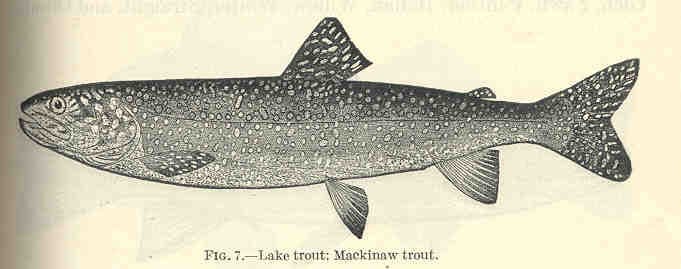
Lake Trout
Salvelinus namaycush
Overview
The lake trout is the largest char species in North America and the apex predator of deep, cold northern lakes. Known regionally as mackinaw, lakers, or grey trout, these fish inhabit the deepest waters of glacially carved lakes across Canada and the northern United States, from the Great Lakes to the isolated mountain lakes of the Rocky Mountains. Lake trout are built for life in deep, cold water, with a deeply forked tail and a metabolism adapted to near-freezing temperatures. While lake trout are commonly associated with trolling and deep-water jigging, they offer outstanding fly fishing opportunities during spring and fall when they move into shallow water to feed and spawn. During ice-out and again in autumn, lake trout can be found cruising shallow shorelines and rocky points, making them vulnerable to streamers and large wet flies cast from shore or a boat.
troutLeast Concern (IUCN) overall; Great Lakes populations were devastated by sea lamprey but have recovered through management programs
Taxonomy
Order
Salmoniformes
Family
Salmonidae
Genus
Salvelinus
Species
S. namaycush
Habitat & Behavior
Deep, cold oligotrophic lakes with rocky structure; moves to shallow water during spring and fall when surface temperatures drop below 55°F
Native Range: Northern North America, from Alaska and Canada south through the Great Lakes and into parts of New England
Introduced Range: Western mountain lakes in Montana, Idaho, Wyoming, and Colorado; several European lakes and South American waters
Diet
Highly piscivorous, feeding on cisco, whitefish, sculpin, smelt, and other prey fish; juveniles consume zooplankton and aquatic invertebrates
Spawning
Lake trout are fall spawners that broadcast their eggs over rocky lake shoals rather than constructing redds like other salmonids. Spawning occurs from September through November when water temperatures drop to around 50°F. Eggs settle into rock crevices and incubate through winter.
Spawning Months
Jan
Feb
Mar
Apr
May
Jun
Jul
Aug
Sep
Oct
Nov
Dec
Spawning Temperature: 46-52°F
Conservation Status
Least Concern (IUCN) overall; Great Lakes populations were devastated by sea lamprey but have recovered through management programs
The Lake Trout is currently classified as Least Concern (IUCN) overall; Great Lakes populations were devastated by sea lamprey but have recovered through management programs. Responsible catch-and-release practices help protect populations for future generations of anglers.
Fly Fishing Tips
Target lake trout on the fly during ice-out in spring and again during the fall spawn when they move into water less than 15 feet deep. Use full-sinking lines and large streamer patterns stripped with erratic, darting retrieves. Rocky points, drop-offs, and shallow reefs are prime holding areas.
Tackle Recommendations
An 8 or 9-weight rod with a fast-sinking line (Type III-V) for reaching deeper water. Use 0X-2X fluorocarbon tippet rated for 12-20 lb test.
Distribution Map
Recommended Fly Patterns
Articulated Minnow #1/0-4
Clouser Minnow #2-6
Woolly Bugger #2-6
Zonker #2-6
Deceiver #1/0-4
Egg-Sucking Leech #2-6
Sculpzilla #2-4
Where to Find Lake Trout


Rivers with Lake Trout


Quick Facts
- Scientific Name
- Salvelinus namaycush
- Family
- trout
- Average Size
- 18-30 inches, 3-10 lbs
- Record Size
- 72 lbs (Great Bear Lake, Northwest Territories, 1995)
- Lifespan
- 15-40 years, with some individuals exceeding 60 years in far northern lakes
- Water Temp Range
- 40-55°F (optimal 46-52°F)
- Native Range
- Northern North America, from Alaska and Canada south through the Great Lakes and into parts of New England
- Conservation
- Least Concern (IUCN) overall; Great Lakes populations were devastated by sea lamprey but have recovered through management programs
Fun Facts
- Lake trout are the longest-lived freshwater fish in North America, with some individuals documented at over 60 years old
- They are the only salmonid species native to the Great Lakes that reproduces entirely within lake environments
- Lake trout populations in Yellowstone Lake threaten native Yellowstone cutthroat trout, and removal efforts have been ongoing since 1994
- A naturally occurring hybrid between lake trout and brook trout is called a splake
Where to Find
Size Reference
Average Size
18-30 inches, 3-10 lbs
World Record
72 lbs (Great Bear Lake, Northwest Territories, 1995)