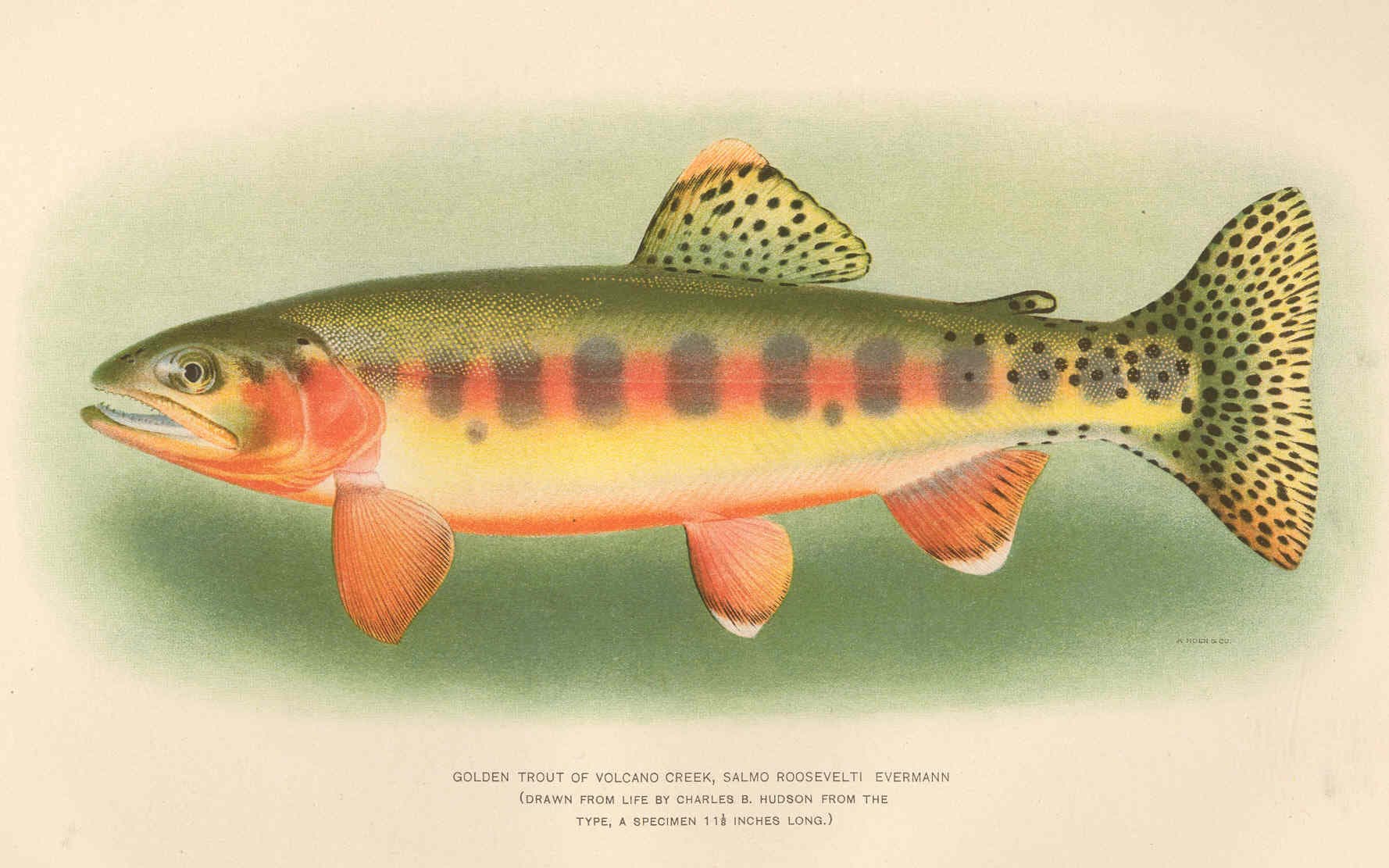
Golden Trout
Oncorhynchus aguabonita
Overview
The golden trout is widely considered the most beautiful freshwater fish in North America. Endemic to a handful of high-elevation streams in the southern Sierra Nevada of California, the golden trout displays a stunning combination of brilliant golden-yellow flanks, vivid red-orange belly and gill plates, olive-green back, and parr marks that persist throughout adulthood. These fish evolved in isolated alpine streams above 8,000 feet in elevation, and their restricted native range makes them one of the rarest and most sought-after trout species on the continent. Backpacking into the high Sierra to catch a wild golden trout in its native habitat is a bucket-list experience for many fly anglers. Though small in size, golden trout feed eagerly on dry flies and offer a fishing experience framed by some of the most spectacular mountain scenery anywhere in the world.
troutSpecies of Special Concern in California; native populations threatened by hybridization with non-native rainbow trout and brown trout
Taxonomy
Order
Salmoniformes
Family
Salmonidae
Genus
Oncorhynchus
Species
O. aguabonita
Habitat & Behavior
High-altitude streams and alpine lakes above 8,000 feet elevation with cold, clear water and gravel substrates
Native Range: Kern River drainage in the southern Sierra Nevada of California, above 8,000 feet elevation
Introduced Range: High-elevation lakes and streams throughout the western United States, including Wyoming, Montana, Idaho, and Colorado
Diet
Primarily aquatic and terrestrial insects including midges, caddisflies, mayflies, ants, and beetles; also consumes freshwater crustaceans at higher elevations
Spawning
Golden trout spawn in late spring and early summer, typically June through August, as snowmelt warms alpine streams to suitable temperatures. Females construct small redds in fine gravel, and the short growing season at high elevation limits reproductive output. Fry emerge in late summer and must grow quickly before winter arrives.
Spawning Months
Jan
Feb
Mar
Apr
May
Jun
Jul
Aug
Sep
Oct
Nov
Dec
Spawning Temperature: 44-52°F
Conservation Status
Species of Special Concern in California; native populations threatened by hybridization with non-native rainbow trout and brown trout
The Golden Trout is currently classified as Species of Special Concern in California; native populations threatened by hybridization with non-native rainbow trout and brown trout. Responsible catch-and-release practices help protect populations for future generations of anglers.
Fly Fishing Tips
Golden trout in their native range are often eager dry fly feeders, particularly on summer afternoons when terrestrial insects are active. Small attractor patterns work well, and delicate presentations are key in the crystal-clear water of alpine environments. Pack light and be prepared for multi-day backcountry trips to reach the best water.
Tackle Recommendations
A 7.5 to 8-foot 3 or 4-weight rod is ideal for small alpine streams. Bring 5X-6X tippet and small dry flies for the gin-clear water.
Distribution Map
Recommended Fly Patterns
Royal Wulff #14-18
Elk Hair Caddis #14-18
Parachute Adams #16-20
Stimulator #12-16
Griffith's Gnat #18-22
Bead Head Prince Nymph #14-18
Foam Beetle #14-16
Where to Find Golden Trout


Rivers with Golden Trout


Quick Facts
- Scientific Name
- Oncorhynchus aguabonita
- Family
- trout
- Average Size
- 6-12 inches, 0.25-1 lb
- Record Size
- 11 lbs 4 oz (Cook Lake, Wyoming, 1948)
- Lifespan
- 5-9 years in native streams, up to 11 years in stocked lakes
- Water Temp Range
- 38-62°F (optimal 42-55°F)
- Native Range
- Kern River drainage in the southern Sierra Nevada of California, above 8,000 feet elevation
- Conservation
- Species of Special Concern in California; native populations threatened by hybridization with non-native rainbow trout and brown trout
Fun Facts
- The golden trout is the state freshwater fish of California
- Native golden trout habitat sits above natural waterfalls that prevented colonization by other trout species for thousands of years
- Some alpine lake populations develop even more intense coloration than stream fish due to dietary differences
- Golden trout can survive at elevations exceeding 12,000 feet, among the highest of any salmonid
Where to Find
Size Reference
Average Size
6-12 inches, 0.25-1 lb
World Record
11 lbs 4 oz (Cook Lake, Wyoming, 1948)