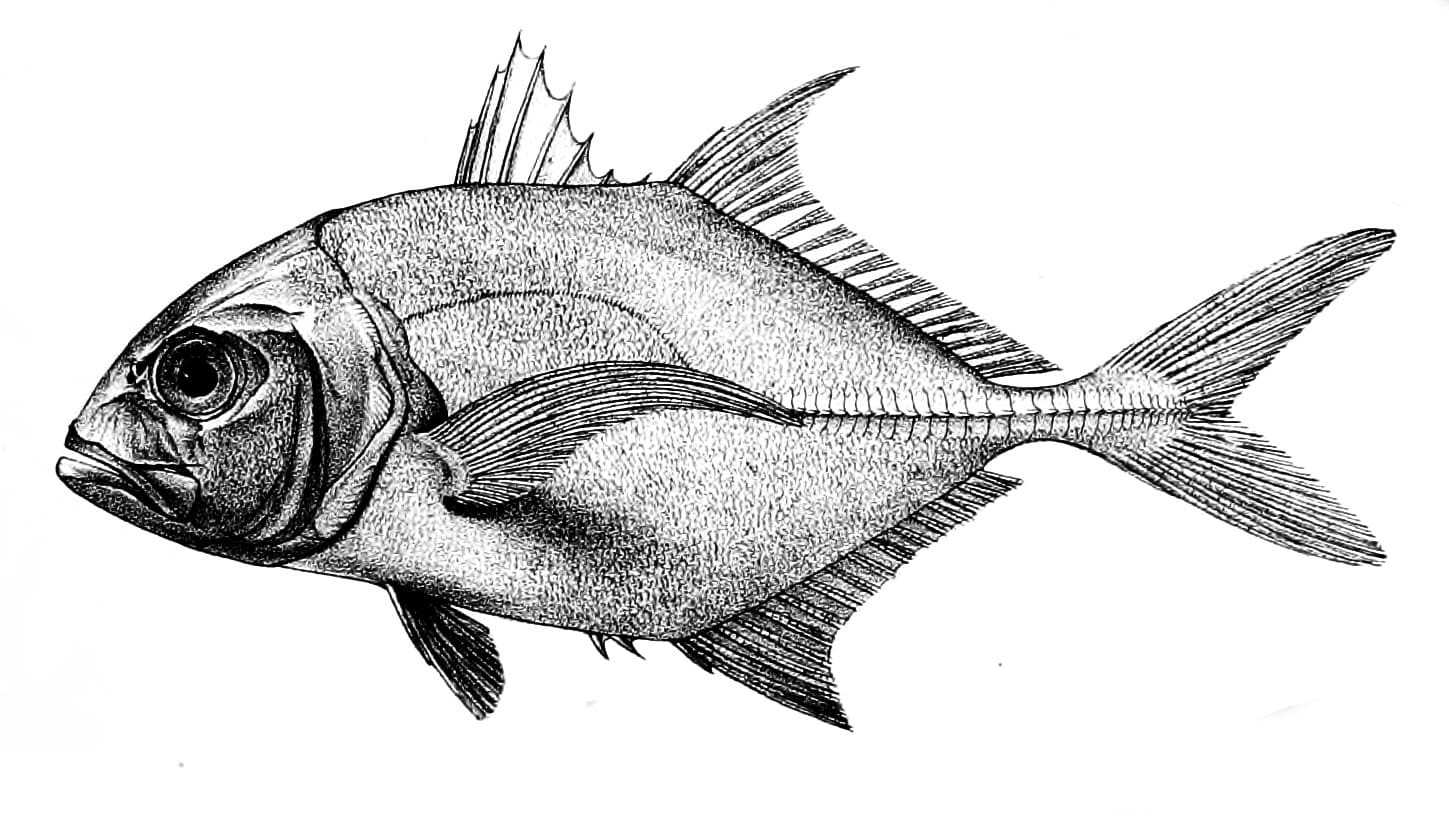
Giant Trevally (GT)
Caranx ignobilis
Overview
The giant trevally, universally known as the GT, is the apex predator of tropical Indo-Pacific flats and reefs, and hooking one on a fly rod is among the most adrenaline-charged experiences in all of fly fishing. GTs are massively built fish with broad, powerful bodies, steep head profiles, and oversized forked tails that generate enormous thrust. They are aggressive, territorial hunters that will charge across a flat at full speed to engulf a popper or streamer in an explosion of white water. Found from the east coast of Africa through the Indian Ocean to Hawaii and beyond, GTs are the marquee species at legendary remote destinations like Christmas Island, the Seychelles, and the atolls of French Polynesia. Fly fishing for GTs demands heavy tackle, accurate casting, and the physical stamina to survive brutal, reel-testing fights. The experience of sight-casting to a GT cruising a coral flat and watching it accelerate toward the fly is an incomparable rush.
saltwaterLeast Concern (IUCN); populations remain healthy in remote atolls but face localized pressure from commercial and recreational fishing near populated areas
Taxonomy
Order
Carangiformes
Family
Carangidae
Genus
Caranx
Species
C. ignobilis
Habitat & Behavior
Coral flats, reef edges, channels, lagoons, and offshore structures throughout the tropical Indo-Pacific; moves onto shallow flats to hunt during tidal shifts
Native Range: Indo-Pacific region from East Africa and the Red Sea through the Indian Ocean to Hawaii, Australia, and Japan
Introduced Range: No introductions; natural distribution throughout the tropical and subtropical Indo-Pacific
Diet
Fish, crabs, lobsters, octopus, squid, and virtually any available prey; GTs are apex predators that have been documented hunting birds, turtles, and even small sharks
Spawning
GTs spawn in large aggregations around the new and full moon during summer months, typically July through October in most of their range. Spawning occurs in deep channels and offshore reef edges. Larvae are pelagic and settle into shallow coastal nursery areas as juveniles.
Spawning Months
Jan
Feb
Mar
Apr
May
Jun
Jul
Aug
Sep
Oct
Nov
Dec
Spawning Temperature: 78-86°F (water temperature)
Conservation Status
Least Concern (IUCN); populations remain healthy in remote atolls but face localized pressure from commercial and recreational fishing near populated areas
The Giant Trevally (GT) is currently classified as Least Concern (IUCN); populations remain healthy in remote atolls but face localized pressure from commercial and recreational fishing near populated areas. Responsible catch-and-release practices help protect populations for future generations of anglers.
Fly Fishing Tips
GTs respond explosively to large poppers stripped aggressively across the surface. When casting to a cruising GT on a flat, place the fly 10-15 feet ahead and strip it fast to trigger an instinctive predatory response. The strip-strike must be forceful to penetrate the GT's tough mouth, and the initial run will test your drag system to its limits.
Tackle Recommendations
A 12-weight rod minimum is required, with 14-weight preferred for trophy fish. Use a reel with at least 300 yards of 50 lb backing and a bombproof drag. Wire or heavy fluorocarbon bite tippet of 80-100 lb is essential.
Distribution Map
Recommended Fly Patterns
Large Popper #4/0-6/0
Brush Fly #4/0-6/0
EP Baitfish #3/0-5/0
Semper Flash #4/0-6/0
Crease Fly #3/0-5/0
Dahlberg Diver #3/0-5/0
Clouser Minnow #2/0-4/0
Where to Find Giant Trevally (GT)


Rivers with Giant Trevally (GT)

Quick Facts
- Scientific Name
- Caranx ignobilis
- Family
- saltwater
- Average Size
- 24-40 inches, 15-40 lbs
- Record Size
- 160 lbs (Tokara Islands, Japan, 2006)
- Lifespan
- 20-25 years, with females generally living longer and growing larger than males
- Water Temp Range
- 72-88°F (optimal 76-84°F)
- Native Range
- Indo-Pacific region from East Africa and the Red Sea through the Indian Ocean to Hawaii, Australia, and Japan
- Conservation
- Least Concern (IUCN); populations remain healthy in remote atolls but face localized pressure from commercial and recreational fishing near populated areas
Fun Facts
- GTs have been filmed leaping from the water to catch terns and other seabirds in mid-flight at remote Pacific atolls
- A large GT can reach speeds of over 40 miles per hour during its attack run on prey
- In Hawaiian culture, the GT (known as ulua) holds spiritual significance and catching one is considered a rite of passage
- GTs are one of the few fish species known to use cooperative hunting strategies, working together to herd prey fish into shallow water
Size Reference
Average Size
24-40 inches, 15-40 lbs
World Record
160 lbs (Tokara Islands, Japan, 2006)