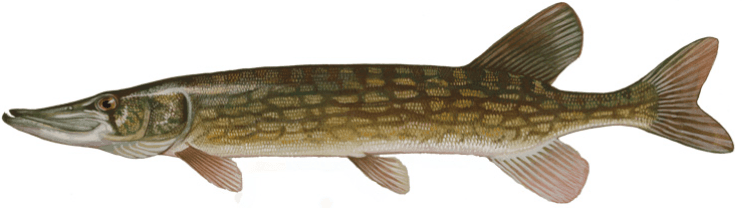
Chain Pickerel
Esox niger
Overview
The chain pickerel is the smallest commonly targeted member of the pike family in North America, but what it lacks in size it more than compensates for with aggressive strikes and willingness to attack flies throughout the year. Named for the distinctive dark chain-link pattern that covers its bright green flanks, the chain pickerel is native to the Atlantic seaboard from Maine to Florida and is the dominant pike-family predator in waters too warm for northern pike and muskellunge. Chain pickerel are ambush predators that lurk among lily pads, submerged vegetation, and fallen timber, striking with remarkable speed and violence. They are an outstanding fly rod species that provides reliable action on days when other species are inactive, particularly during the cooler months of fall, winter, and early spring when chain pickerel continue to feed aggressively. Their accessibility in ponds and small streams near population centers makes them an ideal target for quick fly fishing outings.
pikeLeast Concern; abundant and stable throughout their native range with no significant conservation concerns
Taxonomy
Order
Esociformes
Family
Esocidae
Genus
Esox
Species
E. niger
Habitat & Behavior
Shallow, weedy ponds, lakes, and slow-moving streams and rivers with abundant aquatic vegetation; lily pads, pickerelweed, and submerged timber are preferred ambush cover
Native Range: Atlantic coast of North America from Nova Scotia south to Florida, and west through the Gulf Coast states to the Mississippi drainage
Introduced Range: Limited introductions in Maine and other northeastern states where they coexist with northern pike in some waters
Diet
Small fish (minnows, sunfish, perch), frogs, crayfish, and large aquatic insects; proportionally aggressive predator that will attack prey up to half its own length
Spawning
Chain pickerel are early spring spawners, depositing eggs in shallow, vegetated areas when water temperatures reach 47-52°F in March through April. Eggs adhere to aquatic vegetation and hatch in 6-12 days. No parental care is provided, and newly hatched fry attach to vegetation briefly before becoming free-swimming.
Spawning Months
Jan
Feb
Mar
Apr
May
Jun
Jul
Aug
Sep
Oct
Nov
Dec
Spawning Temperature: 47-52°F
Conservation Status
Least Concern; abundant and stable throughout their native range with no significant conservation concerns
The Chain Pickerel is currently classified as Least Concern; abundant and stable throughout their native range with no significant conservation concerns. Responsible catch-and-release practices help protect populations for future generations of anglers.
Fly Fishing Tips
Chain pickerel are aggressive year-round, making them an excellent cold-weather fly fishing option when other species are dormant. Target edges of lily pads and submerged vegetation with streamers retrieved in quick, darting strips. Weedless flies are essential in heavy cover. Wire or heavy fluorocarbon tippet prevents bite-offs from their sharp teeth.
Tackle Recommendations
A 9-foot 5 or 6-weight rod is ideal for chain pickerel, providing enough power for streamers while maintaining the sport of battling these energetic fish. Use 15-20 lb bite tippet.
Distribution Map
Recommended Fly Patterns
Clouser Minnow #2-6
Woolly Bugger #4-8
Deceiver #2-6
Popper #4-8
Mickey Finn #6-10
Deer Hair Diver #2-6
Bunny Leech #2-6
Where to Find Chain Pickerel


Rivers with Chain Pickerel


Quick Facts
- Scientific Name
- Esox niger
- Family
- pike
- Average Size
- 14-22 inches, 1-3 lbs
- Record Size
- 9 lbs 6 oz (Homerville, Georgia, 1961)
- Lifespan
- 6-10 years, with females growing larger and living longer than males
- Water Temp Range
- 40-78°F (optimal 55-72°F for active feeding, but will feed down to near-freezing temperatures)
- Native Range
- Atlantic coast of North America from Nova Scotia south to Florida, and west through the Gulf Coast states to the Mississippi drainage
- Conservation
- Least Concern; abundant and stable throughout their native range with no significant conservation concerns
Fun Facts
- Chain pickerel are active predators even in near-freezing water, making them one of the best fly fishing targets during the winter months
- Their chain-link pattern is unique among the pike family and provides excellent camouflage among aquatic vegetation
- Chain pickerel are sometimes called the jack pike or just pickerel by New England anglers
- They have proportionally more teeth than northern pike, with over 500 teeth in their jaws at any given time
Where to Find
Size Reference
Average Size
14-22 inches, 1-3 lbs
World Record
9 lbs 6 oz (Homerville, Georgia, 1961)