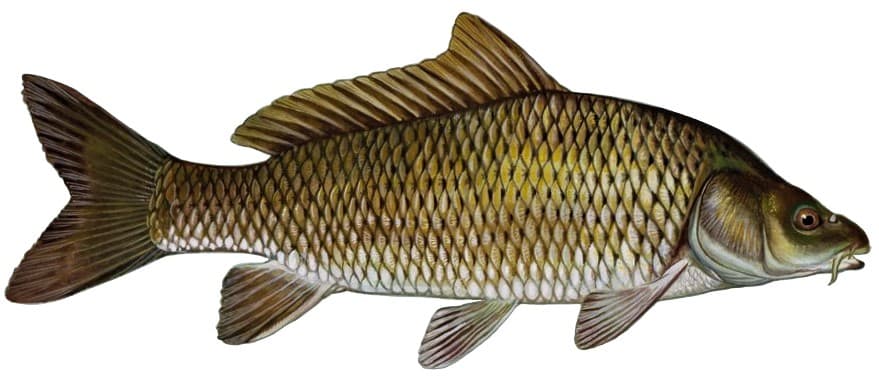
Carp
Cyprinus carpio
Overview
The common carp has undergone a remarkable transformation in the fly fishing world, evolving from a derided rough fish to one of the most challenging and rewarding freshwater species available to fly anglers. Originally native to Asia and eastern Europe, carp have been introduced to waters on every continent except Antarctica and are now the most widely distributed freshwater fish on Earth. Carp are large, powerful, and incredibly wary fish that present a sight fishing challenge comparable to bonefishing on tropical flats. Stalking tailing carp in shallow water with weighted nymphs and crayfish patterns demands stealth, precise casting, and a patient approach that has earned carp the nickname freshwater bonefish among devoted practitioners. When hooked, carp make sustained, drag-testing runs that can strip a hundred yards of backing from the reel, humbling anglers accustomed to the comparatively modest fights of trout.
warmwaterLeast Concern (IUCN); considered invasive in many regions where introduced, but prized as a sport and food fish in Europe and Asia
Taxonomy
Order
Cypriniformes
Family
Cyprinidae
Genus
Cyprinus
Species
C. carpio
Habitat & Behavior
Warm, shallow lakes, ponds, reservoirs, and slow-moving rivers with soft bottoms; muddy flats, weed beds, and flooded shallows where they root for food
Native Range: Central Asia and eastern Europe, from the Danube River basin east through the Caspian and Aral Sea drainages to China and Japan
Introduced Range: Virtually every continent except Antarctica; established in North America since the 1830s, now found in every US state except Alaska
Diet
Omnivorous, feeding on aquatic invertebrates, crayfish, worms, plant matter, algae, seeds, and small mollusks; uses sensitive barbels and a protrusible mouth to detect and vacuum food from soft substrates
Spawning
Carp spawn in late spring and early summer when water temperatures reach 64-75°F. They broadcast eggs over aquatic vegetation in shallow, weedy areas during vigorous spawning displays. A single female can produce over one million eggs. Spawning events are conspicuous, with splashing and thrashing in shallow water.
Spawning Months
Jan
Feb
Mar
Apr
May
Jun
Jul
Aug
Sep
Oct
Nov
Dec
Spawning Temperature: 64-75°F
Conservation Status
Least Concern (IUCN); considered invasive in many regions where introduced, but prized as a sport and food fish in Europe and Asia
The Carp is currently classified as Least Concern (IUCN); considered invasive in many regions where introduced, but prized as a sport and food fish in Europe and Asia. Responsible catch-and-release practices help protect populations for future generations of anglers.
Fly Fishing Tips
Sight fishing for carp requires approaching tailing or cruising fish from behind and presenting the fly several feet ahead of the fish's path. Let the fly sink to the bottom and wait for the carp to approach. Any unnatural movement or splash will spook wary carp instantly. Small, weighted nymph and crayfish patterns in earthy tones are most effective.
Tackle Recommendations
A 9-foot 6 or 7-weight rod with a reliable drag system for handling powerful runs. Use 8-12 lb fluorocarbon tippet and long, fine leaders for the stealthiest presentation.
Distribution Map
Recommended Fly Patterns
Carp Bitters #6-10
Backstabber #6-8
Hybrid Carp Fly #6-8
San Juan Worm #10-14
Woolly Bugger #6-10
Clouser Crayfish #4-8
Carp Carrot #6-8
Where to Find Carp


Rivers with Carp


Quick Facts
- Scientific Name
- Cyprinus carpio
- Family
- warmwater
- Average Size
- 18-28 inches, 5-15 lbs
- Record Size
- 75 lbs 11 oz (Lac de St. Cassien, France, 1987)
- Lifespan
- 15-25 years in most environments, with some individuals exceeding 40 years
- Water Temp Range
- 50-85°F (optimal 70-82°F for active feeding)
- Native Range
- Central Asia and eastern Europe, from the Danube River basin east through the Caspian and Aral Sea drainages to China and Japan
- Conservation
- Least Concern (IUCN); considered invasive in many regions where introduced, but prized as a sport and food fish in Europe and Asia
Fun Facts
- Carp were originally imported to the United States in the 1830s as a food fish and were actively stocked by the US Fish Commission
- Their sensitive barbels can detect amino acids and other chemical signals at concentrations as low as parts per billion
- Carp are one of the longest-lived freshwater fish, with some individuals in Europe documented at over 60 years old
- The fly fishing community has embraced carp to such a degree that dedicated carp-on-fly tournaments now attract hundreds of participants
Size Reference
Average Size
18-28 inches, 5-15 lbs
World Record
75 lbs 11 oz (Lac de St. Cassien, France, 1987)