Bonefish
Albula vulpes
Overview
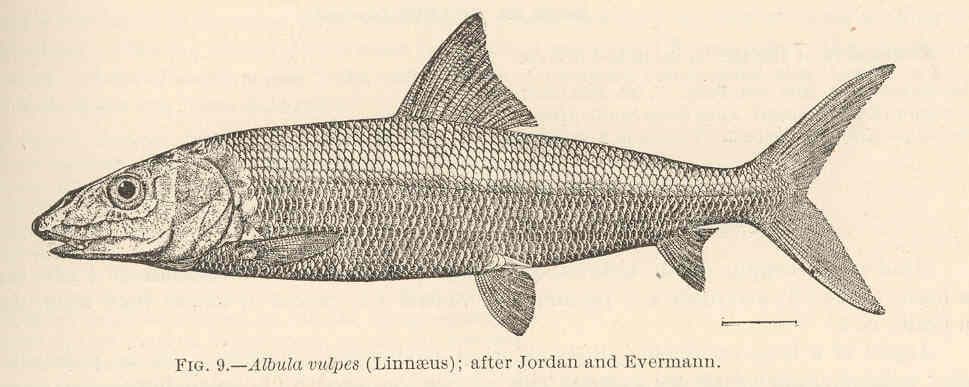
The bonefish is the undisputed king of the saltwater flats and the species that launched the entire saltwater fly fishing revolution. Found on shallow tropical flats throughout the Caribbean, Bahamas, and Indo-Pacific, bonefish are often called the grey ghost for their silvery, torpedo-shaped bodies that seem to materialize out of nowhere on the white sand flats. Sight fishing for bonefish on the flats is considered by many to be the most exciting and visually engaging form of fly fishing, requiring accurate casting, careful wading, and a deep understanding of tidal movements and flat ecology. When hooked, bonefish are famous for their blistering initial run, often peeling off a hundred yards of backing in seconds. The challenge of spotting a tailing or cruising fish, making a precise cast, and then holding on during that first explosive run makes bonefishing an addiction that draws anglers back to the flats year after year.
saltwaterNear Threatened (IUCN); populations in Florida have declined significantly, while Bahamas and Indo-Pacific populations remain relatively healthy
Taxonomy
Order
Albuliformes
Family
Albulidae
Genus
Albula
Species
A. vulpes
Habitat & Behavior
Shallow saltwater flats with sand, turtle grass, and marl bottoms; tidal channels and mangrove edges; water depth typically 6 inches to 3 feet
Native Range: Tropical and subtropical flats worldwide; Caribbean, Bahamas, Florida Keys, Hawaii, and Indo-Pacific from East Africa to French Polynesia
Introduced Range: No introductions; natural distribution throughout tropical and subtropical coastal waters
Diet
Crabs, shrimp, mantis shrimp, clams, sea worms, and small fish found on sandy and grassy flats; feeds by rooting in the substrate, often tailing with their forks exposed above the surface
Spawning
Bonefish spawn offshore in deep water, typically during full moon periods from November through May. Larvae are transparent and ribbon-like, drifting in ocean currents before settling on flats as juveniles. Spawning aggregations can number in the thousands and have been documented off the Bahamas and Florida Keys.
Spawning Months
Jan
Feb
Mar
Apr
May
Jun
Jul
Aug
Sep
Oct
Nov
Dec
Spawning Temperature: 72-82°F (water temperature)
Conservation Status
Near Threatened (IUCN); populations in Florida have declined significantly, while Bahamas and Indo-Pacific populations remain relatively healthy
The Bonefish is currently classified as Near Threatened (IUCN); populations in Florida have declined significantly, while Bahamas and Indo-Pacific populations remain relatively healthy. Responsible catch-and-release practices help protect populations for future generations of anglers.
Fly Fishing Tips
Accurate casting is the single most important skill in bonefishing. Practice casting 40-60 feet accurately in wind before your trip. Lead the fish by 6-10 feet and let the fly sink before beginning a slow, steady strip retrieve. Tailing fish are feeding actively and are the best targets.
Tackle Recommendations
A 9-foot 8-weight rod is the standard bonefish setup. Use a weight-forward floating tropical line and 10-12 lb fluorocarbon tippet. Bring a reel with a smooth, reliable drag and at least 150 yards of backing.
Distribution Map
Recommended Fly Patterns
Gotcha #4-8
Crazy Charlie #4-8
Christmas Island Special #6
Mantis Shrimp #4-6
Bonefish Bitter #4-6
Clouser Minnow #4-6
Spawning Shrimp #6-8
Where to Find Bonefish


Rivers with Bonefish

Quick Facts
- Scientific Name
- Albula vulpes
- Family
- saltwater
- Average Size
- 18-26 inches, 3-8 lbs
- Record Size
- 16 lbs (Biscayne Bay, Florida, 2007)
- Lifespan
- 15-20 years, making them relatively long-lived for their size
- Water Temp Range
- 68-88°F (optimal 75-85°F)
- Native Range
- Tropical and subtropical flats worldwide; Caribbean, Bahamas, Florida Keys, Hawaii, and Indo-Pacific from East Africa to French Polynesia
- Conservation
- Near Threatened (IUCN); populations in Florida have declined significantly, while Bahamas and Indo-Pacific populations remain relatively healthy
Fun Facts
- Bonefish can accelerate from zero to 30 miles per hour in seconds, making their initial run one of the most thrilling experiences in all of fly fishing
- Their crushing pharyngeal teeth can crack open the shells of crabs, clams, and sea urchins
- Bonefish were the first saltwater species to be widely targeted on fly tackle, launching the saltwater fly fishing movement in the 1950s
- They can detect the vibrations of prey buried several inches beneath the sand using sensitive lateral line receptors
Where to Find
Size Reference
Average Size
18-26 inches, 3-8 lbs
World Record
16 lbs (Biscayne Bay, Florida, 2007)