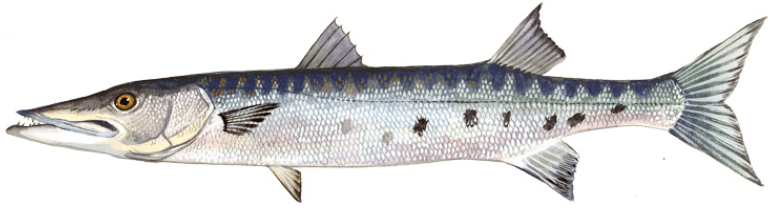
Barracuda
Sphyraena barracuda
Overview
The great barracuda is one of the fastest and most explosive predators in tropical waters, capable of bursting from a standstill to over 35 miles per hour in a fraction of a second to slash through schools of baitfish. With their elongated, torpedo-shaped bodies, prominent underbite filled with razor-sharp teeth, and fierce predatory behavior, barracuda have a fearsome reputation that belies their outstanding qualities as a fly rod game fish. Found throughout the tropical and subtropical Atlantic and Indo-Pacific, barracuda are commonly encountered on the same flats and reefs where anglers target bonefish, permit, and tarpon. While often dismissed as a bycatch species, sight fishing for large barracuda on shallow flats with long, slender needlefish patterns and a high-speed retrieve is a genuinely thrilling pursuit. The explosive strike and initial run of a big barracuda are among the most violent in saltwater fly fishing.
saltwaterLeast Concern (IUCN); populations are healthy throughout most of their range, though large individuals are increasingly rare near populated coastlines
Taxonomy
Order
Istiophoriformes
Family
Sphyraenidae
Genus
Sphyraena
Species
S. barracuda
Habitat & Behavior
Shallow flats, reef edges, channels, wrecks, and mangrove shorelines in tropical waters; also found over deep reefs and in open water near structure
Native Range: Circumtropical distribution in the Atlantic, Indian, and Pacific Oceans; abundant throughout the Caribbean, Bahamas, and Florida Keys
Introduced Range: No introductions; naturally distributed throughout tropical and subtropical marine waters worldwide
Diet
Fish of all types including jacks, grouper, snapper, mullet, and needlefish; barracuda are visual predators that rely on speed and ambush tactics to overpower prey
Spawning
Barracuda spawn in offshore waters throughout the year in tropical regions, with peak activity during spring and summer months. They release pelagic eggs that hatch within 48 hours. Juveniles seek shelter in mangrove estuaries and seagrass beds where they grow rapidly, reaching maturity at 2-3 years of age.
Spawning Months
Jan
Feb
Mar
Apr
May
Jun
Jul
Aug
Sep
Oct
Nov
Dec
Spawning Temperature: 74-84°F (water temperature)
Conservation Status
Least Concern (IUCN); populations are healthy throughout most of their range, though large individuals are increasingly rare near populated coastlines
The Barracuda is currently classified as Least Concern (IUCN); populations are healthy throughout most of their range, though large individuals are increasingly rare near populated coastlines. Responsible catch-and-release practices help protect populations for future generations of anglers.
Fly Fishing Tips
Barracuda are visual predators that respond to fast, erratic retrieves. Use long, slender flies that imitate needlefish and strip as fast as you possibly can. The fly should be moving at maximum speed when it enters the barracuda's strike zone. Wire tippet is absolutely essential, as barracuda teeth will slice through fluorocarbon instantly.
Tackle Recommendations
A 9-foot 9 or 10-weight rod for casting large flies. Wire bite tippet of 30-40 lb is mandatory. Use an intermediate or floating line depending on water depth.
Distribution Map
Recommended Fly Patterns
Needlefish Pattern #2/0-4/0
Long Deceiver #2/0-4/0
Tube Fly #2/0-4/0
EP Baitfish #2/0-4/0
Popovics Surf Candy #1/0-3/0
Wire Clouser #1/0-3/0
Flashy Brush Fly #2/0-4/0
Where to Find Barracuda


Rivers with Barracuda

Quick Facts
- Scientific Name
- Sphyraena barracuda
- Family
- saltwater
- Average Size
- 24-40 inches, 5-15 lbs
- Record Size
- 85 lbs (Christmas Island, Kiribati, 1992)
- Lifespan
- 12-18 years in the wild
- Water Temp Range
- 68-88°F (optimal 74-84°F)
- Native Range
- Circumtropical distribution in the Atlantic, Indian, and Pacific Oceans; abundant throughout the Caribbean, Bahamas, and Florida Keys
- Conservation
- Least Concern (IUCN); populations are healthy throughout most of their range, though large individuals are increasingly rare near populated coastlines
Fun Facts
- Barracuda can accelerate from stationary to over 35 miles per hour in a single body length, making them one of the fastest-accelerating fish in the ocean
- Their teeth are so sharp that they have been used by indigenous peoples as cutting tools and arrowheads
- Large barracuda over 30 pounds can carry ciguatera toxin accumulated through the food chain, making them unsafe to eat in some regions
- Barracuda are attracted to shiny objects and reflections, which is why long, flashy flies with metallic materials are so effective
Where to Find
Size Reference
Average Size
24-40 inches, 5-15 lbs
World Record
85 lbs (Christmas Island, Kiribati, 1992)